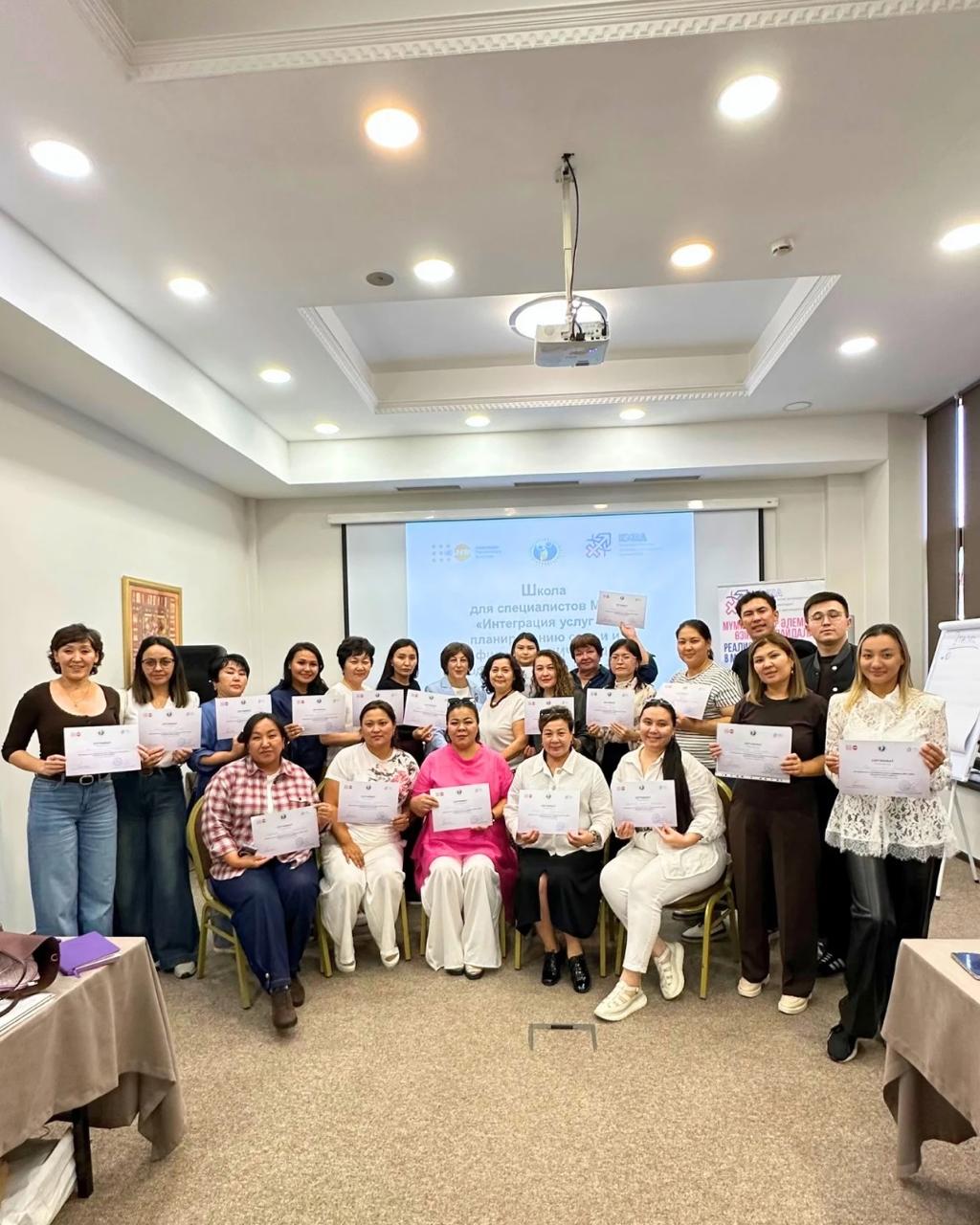
On September 18, a three-day School for Specialists from Youth Health Centers (YHCs) on the integration of family planning services, HIV and STI prevention concluded in Almaty. A total of 36 regional coordinators, managers and specialists from YHCs across Kazakhstan took part in the training.
The event was organized by the Kazakhstan Association for Sexual and Reproductive Health (KMPA), with the support of the National Commission for Women’s Affairs and Family and Demographic Policy under the President of the Republic of Kazakhstan, the Ministry of Health of the Republic of Kazakhstan and the United Nations Population Fund (UNFPA). The initiative was implemented as part of the fulfillment of the instructions of the Head of State to promote youth health, protect motherhood and childhood, and provide comprehensive social support to the younger generation.
Over the course of three days, participants improved their practical skills in counseling on contraception and dual protection, HIV and STI prevention, rapid HIV testing, pre- and post-test counseling, pre- and post-exposure prophylaxis, emergency contraception, and referring young people to appropriate services.
The key theme of the training was the integration of services based on the “single-window” principle, which allows adolescents and young people to receive comprehensive, confidential and youth-friendly assistance through a single point of access. The training was based on recommendations developed in 2026 by national experts of the ILC, with the support of UNFPA, on the integration of family planning, HIV and STI prevention services into the work of Youth Health Centers.
The practical part included analysis of clinical cases, role-playing exercises, practicing counseling and testing skills, as well as an off-site practical session. As a result of the School, participants developed team plans for implementing an integrated approach in Youth Health Centers in their respective regions.
“The health of adolescents and young people is an investment not only in the health of future generations, but also in the well-being of the family and society as a whole. As a member of the National Commission for Women’s Affairs and Family and Demographic Policy under the President of the Republic of Kazakhstan, I consider it especially important that young people in all regions of the country have access to high-quality, confidential and non-discriminatory assistance. The ‘single-window’ principle in Youth Health Centers makes it possible to combine family planning, HIV and STI prevention, counseling and necessary referrals based on the needs of the young person. It is important that the knowledge gained by specialists during the School becomes part of the daily practice of YHCs throughout the country,” said Galina Grebennikova, member of the National Commission for Women’s Affairs and Family and Demographic Policy under the President of the Republic of Kazakhstan and Executive Director of the KMPA.
The participants of the School highly appreciated the practical focus of the training, the opportunity to exchange experience with colleagues from different regions, and the relevance of an integrated approach to the work of Youth Health Centers.
“Practical cases and role-playing exercises were especially useful. They helped us understand how the ‘single-window’ principle can be applied in the daily work of Youth Health Centers.”
“The training combined contraception, HIV and STI prevention into a single algorithm for working with a young person. This is exactly the practical approach that Youth Health Center specialists need.”
“It is important that we leave not only with new knowledge, but also with a specific plan for implementing integrated services in our region.”
During the discussion, participants also identified areas that need to be further strengthened, including more active interaction between Youth Health Centers and parents of adolescents, teachers, school psychologists, heads of schools, colleges and other educational organizations.
Particular attention was paid to developing joint preventive visits by parents with children under the age of 16 to Youth Health Centers, as well as strengthening awareness among adolescents and parents about Youth Health Centers, available services and treatment options, including which services are confidential and provided free of charge.
Participants also noted the need to establish a consistent system for referring adolescents from schools and primary healthcare organizations to Youth Health Centers, with a clear feedback mechanism; strengthen interdisciplinary cooperation between Youth Health Center specialists, doctors, psychologists, social workers and other professionals based on the “single-window” principle; and develop digital communication channels with young people, including online counseling, pre-registration, reliable health information and access to information about specialists providing assistance.
