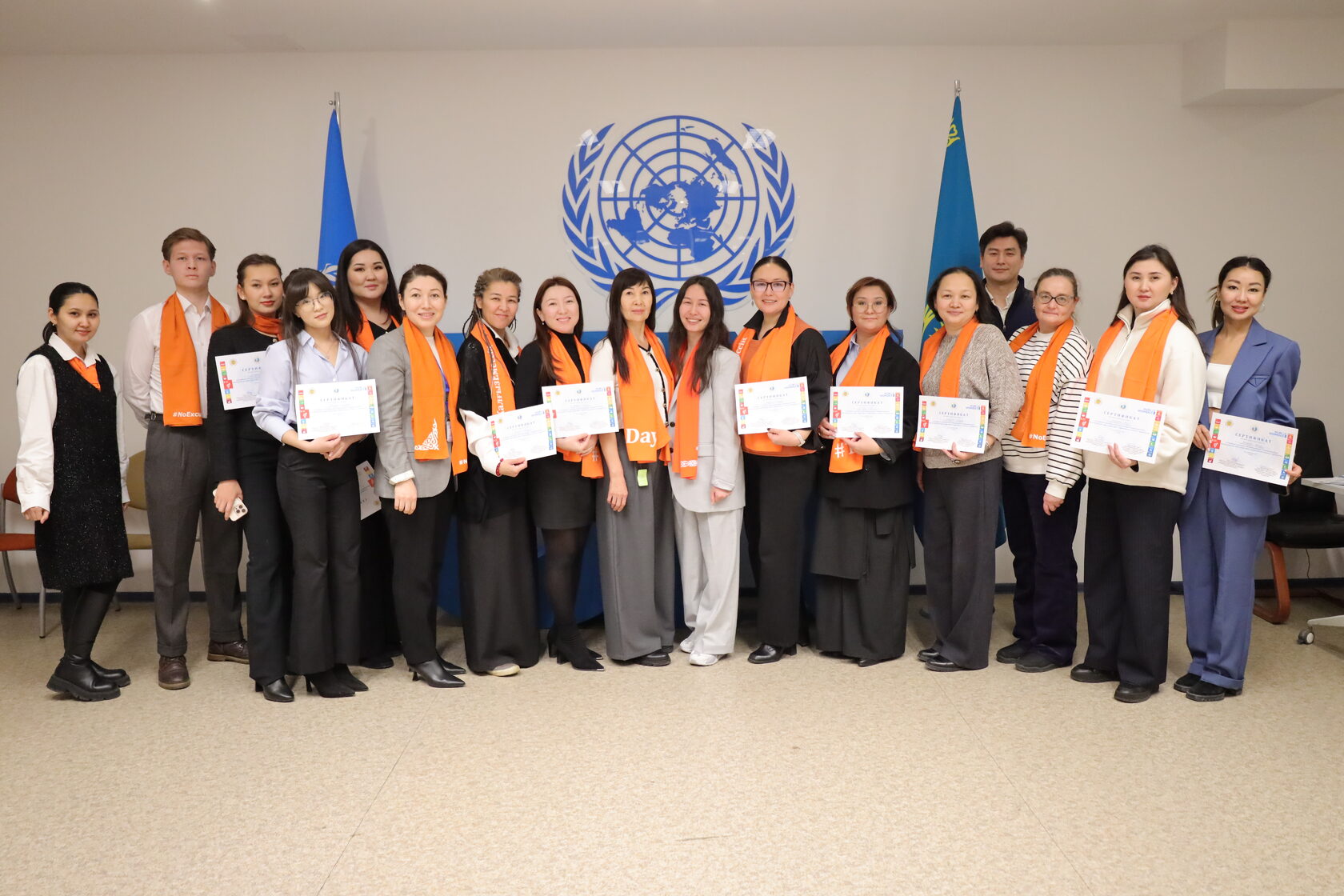
Today, 26 November, press secretaries of government agencies and media representatives gathered at the UN building in the capital to discuss one of the most relevant topics in today’s information space: gender-sensitive communication.
The training was organized by UN Women with the support of the National Commission for Women Affairs, Family and Demographic Policy under the President of the Republic of Kazakhstan and the Ministry of Culture and Information of the Republic of Kazakhstan.
The official opening was delivered by Elena Tarasenko, Deputy Chairperson of the National Commission, and Ceren Güven Güres, Head of the UN Women Coordination Office in Central Asia. The speakers emphasized the importance of adhering to the principles of gender equality in the information domain and highlighted the crucial role of the media in shaping public perceptions.
“Every word is an instrument that influences public opinion. Therefore, in professional communication, ethics and accuracy carry special significance. This training aims to strengthen gender-sensitive communication between government agencies and the media, enhance ethical standards in the information space, and promote fair and accessible coverage of women and vulnerable groups,”
— noted Elena Tarasenko.
The session was facilitated by Moldir Utegenova, National Expert of UN Women in Kazakhstan, who introduced participants to effective communication methods aligned with international standards and local context.
During the opening sessions, participants discussed why gender-sensitive language matters, how wording affects audience perception, and the ways in which media shape social attitudes.
The theoretical part was followed by hands-on exercises, including:
– analysis of real media materials,
– identification of problematic formulations,
– rewriting visual and textual content,
– exploring the impact of stereotypes on women, men, and different social groups.
Participants also studied the specifics of reporting on sensitive topics — conflict, violence, politics, and social roles — and reviewed principles for avoiding victim-blaming.
In the second half of the day, an overview of international experience was presented, covering gender policies of leading newsrooms, UN Women and OSCE projects, as well as successful Kazakhstani initiatives, including Batyr Zhamal.
The final session took place in a mini-newsroom format: participants rapidly analyzed news texts, identified potential issues, and adapted materials in line with ethical and inclusive communication standards.
At the close of the event, attendees outlined concrete steps they will apply in their professional practice. Checklists were distributed, followed by a group photo session.
The training was organized by UN Women with the support of the National Commission for Women Affairs, Family and Demographic Policy under the President of the Republic of Kazakhstan and the Ministry of Culture and Information of the Republic of Kazakhstan.
The official opening was delivered by Elena Tarasenko, Deputy Chairperson of the National Commission, and Ceren Güven Güres, Head of the UN Women Coordination Office in Central Asia. The speakers emphasized the importance of adhering to the principles of gender equality in the information domain and highlighted the crucial role of the media in shaping public perceptions.
“Every word is an instrument that influences public opinion. Therefore, in professional communication, ethics and accuracy carry special significance. This training aims to strengthen gender-sensitive communication between government agencies and the media, enhance ethical standards in the information space, and promote fair and accessible coverage of women and vulnerable groups,”
— noted Elena Tarasenko.
The session was facilitated by Moldir Utegenova, National Expert of UN Women in Kazakhstan, who introduced participants to effective communication methods aligned with international standards and local context.
During the opening sessions, participants discussed why gender-sensitive language matters, how wording affects audience perception, and the ways in which media shape social attitudes.
The theoretical part was followed by hands-on exercises, including:
– analysis of real media materials,
– identification of problematic formulations,
– rewriting visual and textual content,
– exploring the impact of stereotypes on women, men, and different social groups.
Participants also studied the specifics of reporting on sensitive topics — conflict, violence, politics, and social roles — and reviewed principles for avoiding victim-blaming.
In the second half of the day, an overview of international experience was presented, covering gender policies of leading newsrooms, UN Women and OSCE projects, as well as successful Kazakhstani initiatives, including Batyr Zhamal.
The final session took place in a mini-newsroom format: participants rapidly analyzed news texts, identified potential issues, and adapted materials in line with ethical and inclusive communication standards.
At the close of the event, attendees outlined concrete steps they will apply in their professional practice. Checklists were distributed, followed by a group photo session.