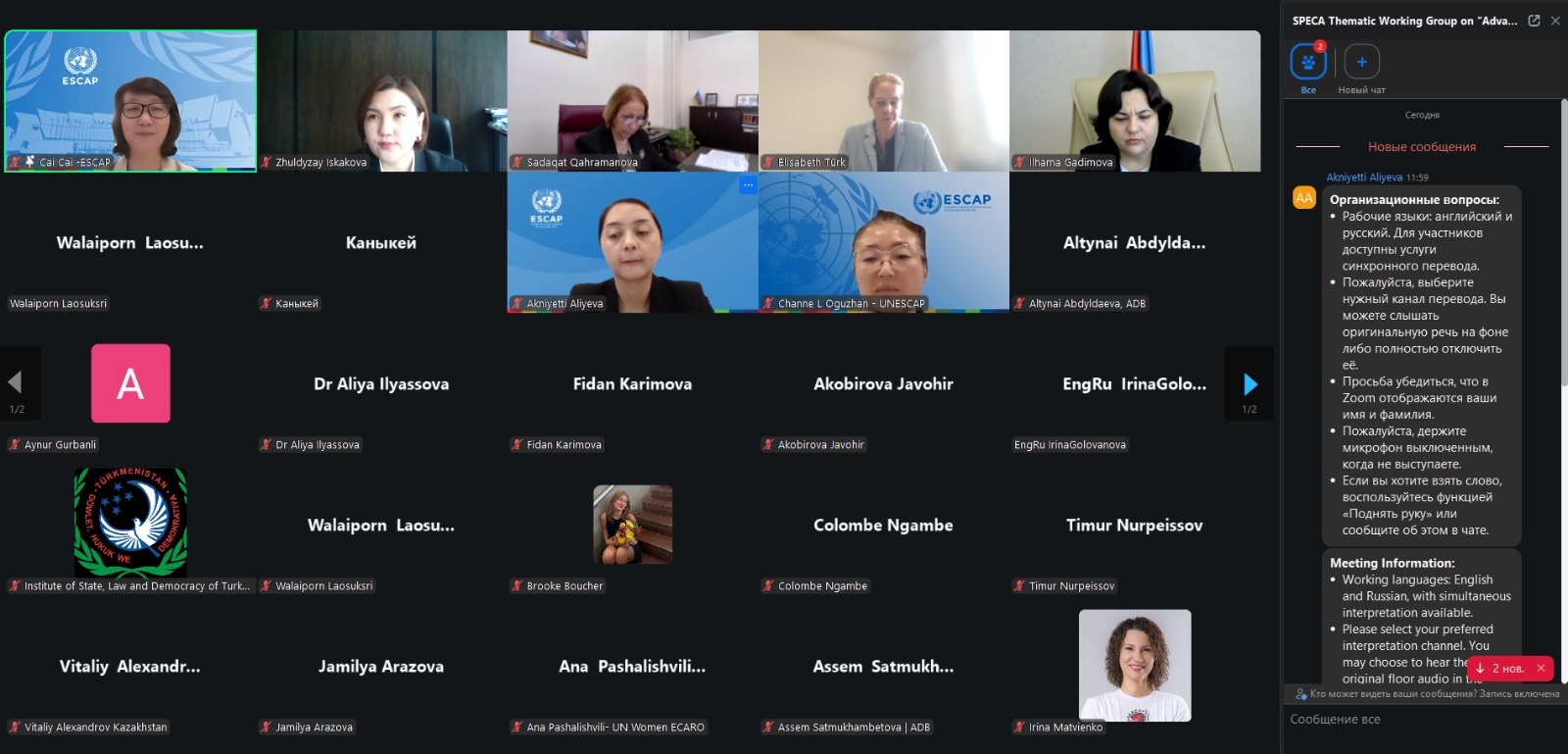
On September 16, Deputy Chairman of the National Commission for Women’s Affairs and Family and Demographic Policy under the President of the Republic of Kazakhstan, Chairman of the Board of the Kazakhstan Institute for Social Development Zhuldyzai Iskakova participated in the annual online meeting of the SPECA Working Group on Gender and the Sustainable Development Goals.
SPECA is the United Nations Special Programme for the Economies of Central Asia, which brings together countries of the region to promote economic cooperation and support the achievement of the Sustainable Development Goals.
This year, the discussion focused on the issue of women’s economic empowerment in the context of digital and green transformation. For the countries of the region, this agenda is of particular importance against the background of the rapid development of technology, the emergence of new professions and the changing structure of the economy. The 2026 meeting specifically addressed advancing women’s economic empowerment in the context of digital and green economies.
Today, women make up almost half of the employed population of Kazakhstan and head 48% of small and medium-sized businesses. In 2026, declared the Year of Digitalization and Artificial Intelligence, women’s access to AI competencies, technological entrepreneurship, e-commerce and new financial instruments is of particular importance.
One of the practical examples is the IT-Aiel project, implemented by TechnoWomen with the support of the National Commission. The project is aimed at retraining unemployed women and women returning to the labor market after parental leave. Participants learn new digital professions and skills in the field of artificial intelligence, software testing, chatbot creation and e-commerce, as well as gain knowledge of financial literacy, the basics of entrepreneurship and digital hygiene. In three years, more than 21,000 women have completed the training.
“The next step for Kazakhstan is to expand the presence of women among those who not only use technology, but create it. Digital skills should be linked to access to finance, entrepreneurial support and markets,” said Zhuldyzai Iskakova.
The Kazakh side also suggested moving from the exchange of experience to practical subregional cooperation. In particular, this includes the creation of comparable data on women’s participation in the digital and green economy, the creation of a bank of effective practices, and the launch of joint pilot projects.