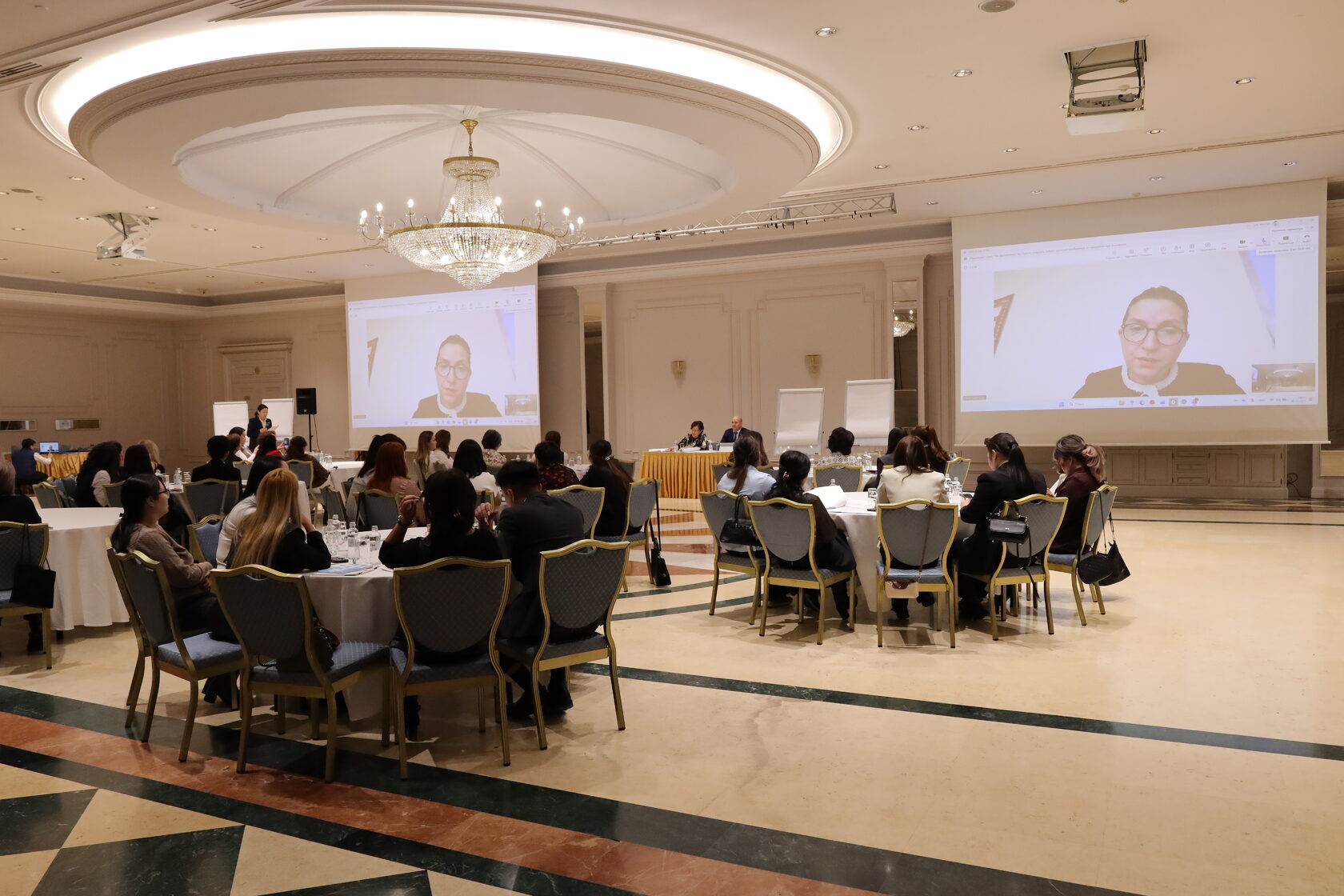
The National Commission for Women Affairs, Family and Demographic Policy under the President of the Republic of Kazakhstan continues to strengthen measures for the protection of individuals affected by violence. On November 20–21, a two-day specialized training was held for psychologists from Family Support Centers, aimed at developing professional skills in providing high-quality psychological assistance to women and children during investigation and court proceedings.
The training was organized with the support of the National Commission, under the UN Women–Ministry of Culture and Information of the Republic of Kazakhstan grant program for 2025–2027.
The sessions were led by Sagadat Sabitova, UN Women National Expert on Gender Equality and Prevention of Domestic Violence. The opening ceremony was attended by Renat Zulkhairov, Member of the National Commission and Head of the Department for Legal and Normative Coordination at the Ministry of Internal Affairs (Police Colonel), and Ceren Güven Güres, Head of UN Women in Kazakhstan. Participants emphasized the importance of strengthening the professional capacity of specialists providing assistance to survivors of violence, as well as enhancing interagency cooperation.
Over the two days, psychologists studied modern approaches to working with survivors of gender-based and domestic violence. The program covered the impact of stereotypes and social biases, dynamics of abusive relationships, and included practical sessions on risk assessment, safety planning, and support during investigative and judicial procedures. Special focus was given to cases involving children and women with disabilities.
A dedicated block addressed legislative changes (2022–2025), mechanisms of cooperation with law enforcement and judicial bodies, case analysis, and preparation of children for participation in court hearings. The training also included modules on preventing emotional burnout, ensuring personal safety, and developing professional resilience among specialists.
Particular attention was given to facilitation skills, enabling psychologists to conduct internal training sessions in their own centers and transfer the acquired methodologies to colleagues.
Upon completion of the training, specialists gained competencies to work based on trauma-informed and gender-sensitive approaches, prevent re-victimization, and effectively support women and children during investigations and trials, while also building collaboration with law enforcement and organizing peer learning. These skills will contribute to strengthening Kazakhstan’s national system for combating domestic violence and improving the quality of social and psychological services.
The training concluded on November 21 with a post-training evaluation, group discussion, and planning session on integrating new approaches into the daily work of Family Support Centers.
The National Commission will continue to focus on enhancing the professional capacity of specialists, implementing modern service standards, and developing interagency cooperation in supporting women and children across Kazakhstan.
The training was organized with the support of the National Commission, under the UN Women–Ministry of Culture and Information of the Republic of Kazakhstan grant program for 2025–2027.
The sessions were led by Sagadat Sabitova, UN Women National Expert on Gender Equality and Prevention of Domestic Violence. The opening ceremony was attended by Renat Zulkhairov, Member of the National Commission and Head of the Department for Legal and Normative Coordination at the Ministry of Internal Affairs (Police Colonel), and Ceren Güven Güres, Head of UN Women in Kazakhstan. Participants emphasized the importance of strengthening the professional capacity of specialists providing assistance to survivors of violence, as well as enhancing interagency cooperation.
Over the two days, psychologists studied modern approaches to working with survivors of gender-based and domestic violence. The program covered the impact of stereotypes and social biases, dynamics of abusive relationships, and included practical sessions on risk assessment, safety planning, and support during investigative and judicial procedures. Special focus was given to cases involving children and women with disabilities.
A dedicated block addressed legislative changes (2022–2025), mechanisms of cooperation with law enforcement and judicial bodies, case analysis, and preparation of children for participation in court hearings. The training also included modules on preventing emotional burnout, ensuring personal safety, and developing professional resilience among specialists.
Particular attention was given to facilitation skills, enabling psychologists to conduct internal training sessions in their own centers and transfer the acquired methodologies to colleagues.
Upon completion of the training, specialists gained competencies to work based on trauma-informed and gender-sensitive approaches, prevent re-victimization, and effectively support women and children during investigations and trials, while also building collaboration with law enforcement and organizing peer learning. These skills will contribute to strengthening Kazakhstan’s national system for combating domestic violence and improving the quality of social and psychological services.
The training concluded on November 21 with a post-training evaluation, group discussion, and planning session on integrating new approaches into the daily work of Family Support Centers.
The National Commission will continue to focus on enhancing the professional capacity of specialists, implementing modern service standards, and developing interagency cooperation in supporting women and children across Kazakhstan.