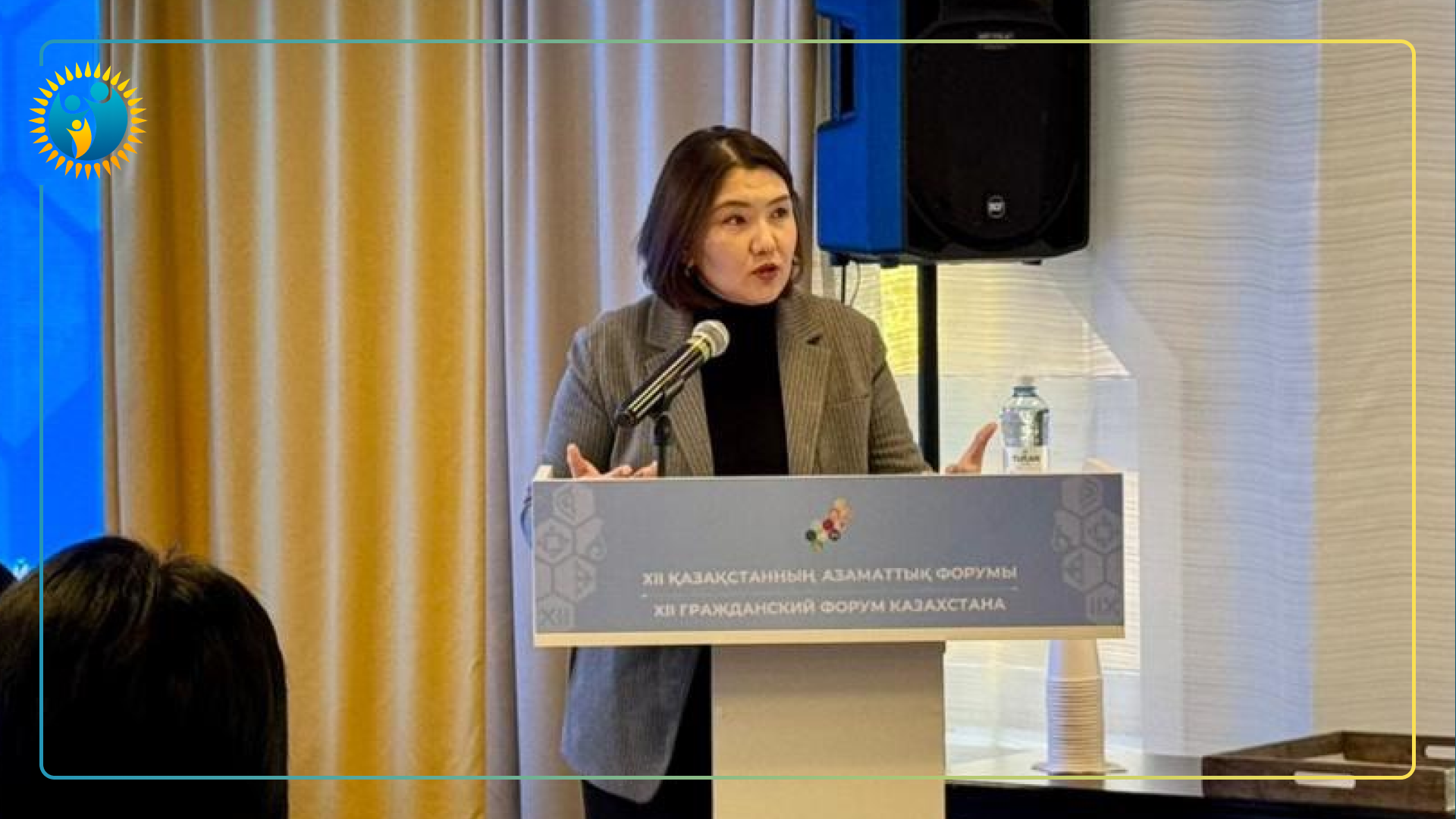
On October 15, in Astana, as part of the XII Civil Forum of Kazakhstan, a session was held dedicated to the interaction between state and public institutions in strengthening the institution of the family.
The main goal of the event was to find joint solutions for developing a culture of conscious parenthood and enhancing the role of social institutions in supporting families.
On behalf of the National Commission for Women Affairs, Family and Demographic Policy under the President of the Republic of Kazakhstan, the Deputy Chairperson of the Commission and Advisor to the Chairperson of the Senate of the Parliament of Kazakhstan, Zhuldizay Ismagulova, delivered a report on how analytics and data contribute to building effective family policy.
The speaker emphasized that in an era of information overload, it is especially important to distinguish between emotions and facts. As an example, she referred to a case of fake information spreading online about a supposedly record-high divorce rate in Kazakhstan — data that was not supported by official national statistics or by the United Nations.
“Such misinformation distorts the real picture and undermines public trust in state policy,” noted Ismagulova. “That is why every conclusion must be based on verified data and transparent analytics.”
Reference: In 2024, the marriage rate in Kazakhstan stood at 6.13 per 1,000 people, while the divorce rate was 2.01. The share of dissolved marriages has decreased by almost 5 percentage points over the past four years.
According to Ismagulova, today Kazakhstan’s family policy is built on evidence-based approaches and modern analytical tools. Its foundation includes demographic yearbooks, sociological surveys, and national reports “Kazakhstani Families,” published since 2020, as well as digital solutions such as the Digital Family Map and the FSM Social system. The latter enables interagency coordination in supporting families, helps to promptly identify households in difficult life situations, and ensures targeted assistance without excessive bureaucracy.
The discussion also brought together representatives of government bodies, non-governmental organizations, and public associations. The session was moderated by Zhansaya Ismagulova, Chairperson of the Public Association Senimen Bolashak.
The main goal of the event was to find joint solutions for developing a culture of conscious parenthood and enhancing the role of social institutions in supporting families.
On behalf of the National Commission for Women Affairs, Family and Demographic Policy under the President of the Republic of Kazakhstan, the Deputy Chairperson of the Commission and Advisor to the Chairperson of the Senate of the Parliament of Kazakhstan, Zhuldizay Ismagulova, delivered a report on how analytics and data contribute to building effective family policy.
The speaker emphasized that in an era of information overload, it is especially important to distinguish between emotions and facts. As an example, she referred to a case of fake information spreading online about a supposedly record-high divorce rate in Kazakhstan — data that was not supported by official national statistics or by the United Nations.
“Such misinformation distorts the real picture and undermines public trust in state policy,” noted Ismagulova. “That is why every conclusion must be based on verified data and transparent analytics.”
Reference: In 2024, the marriage rate in Kazakhstan stood at 6.13 per 1,000 people, while the divorce rate was 2.01. The share of dissolved marriages has decreased by almost 5 percentage points over the past four years.
According to Ismagulova, today Kazakhstan’s family policy is built on evidence-based approaches and modern analytical tools. Its foundation includes demographic yearbooks, sociological surveys, and national reports “Kazakhstani Families,” published since 2020, as well as digital solutions such as the Digital Family Map and the FSM Social system. The latter enables interagency coordination in supporting families, helps to promptly identify households in difficult life situations, and ensures targeted assistance without excessive bureaucracy.
The discussion also brought together representatives of government bodies, non-governmental organizations, and public associations. The session was moderated by Zhansaya Ismagulova, Chairperson of the Public Association Senimen Bolashak.