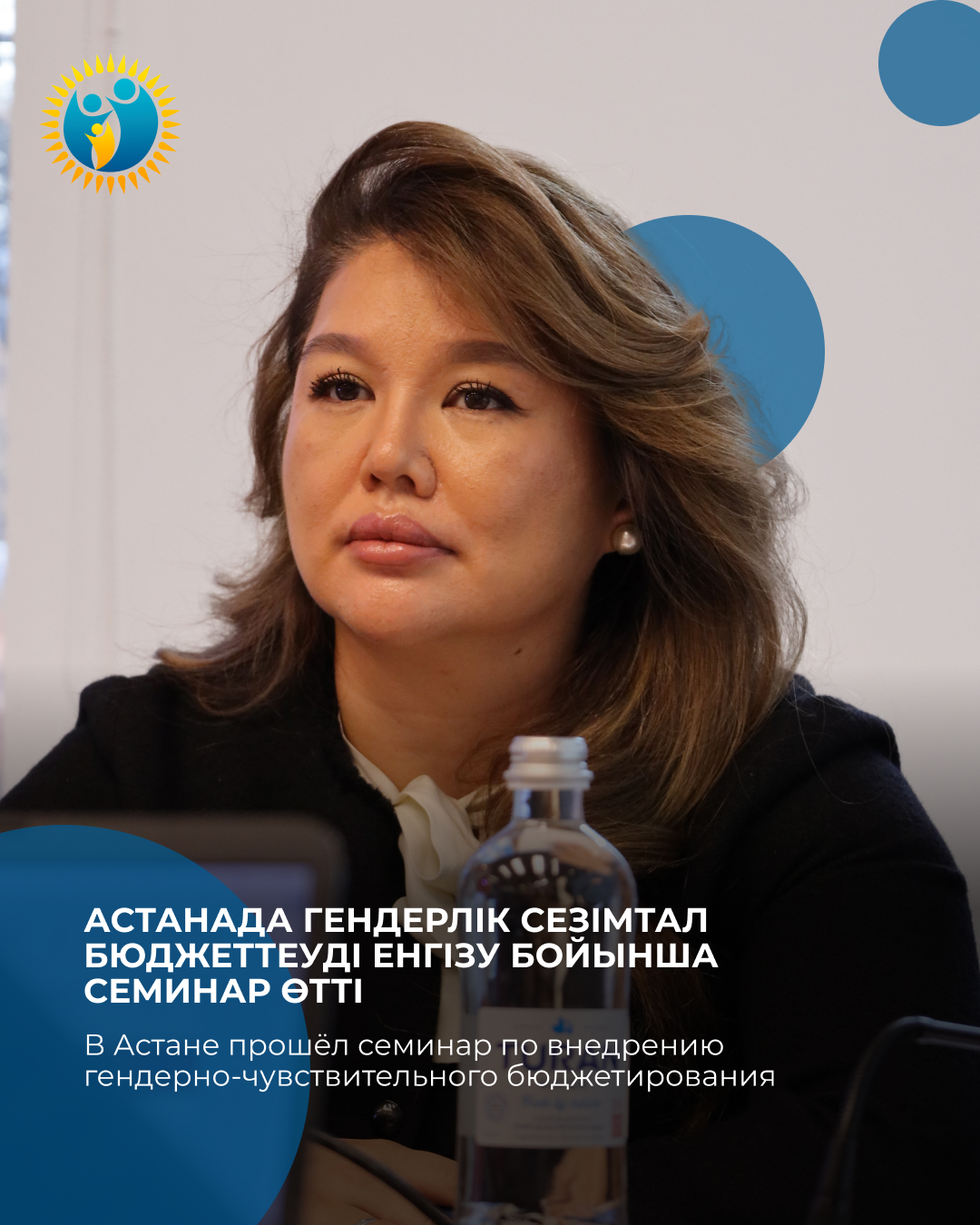
On October 22–23, the two-day seminar “Implementation of Gender-Responsive Budgeting” was held at the UN Office in Astana, organized by UN Women in cooperation with the National Commission for Women Affairs, Family and Demographic Policy under the President of the Republic of Kazakhstan.
The event gathered representatives of government bodies, experts in strategic planning and finance, as well as international consultants. The training was conducted by Alexander Kovalevsky, UN Women international expert and Director General of the Institute for Budgetary Solutions.
Opening the seminar, Zhuldiz Davletbayeva, representative of the National Commission, emphasized that gender-responsive budgeting (GRB) is an important tool for improving transparency and effectiveness in fiscal policy.
“Gender budgeting allows us to better understand the impact of policy decisions and see how resource allocation affects the lives of women and men. It is a practical tool that makes public spending more equitable and targeted,”— noted Zh. Davletbayeva.
Since gaining independence, Kazakhstan has developed a comprehensive framework to promote gender equality. Key legislative and policy documents include the Strategy for Gender Equality (2006–2016), the Law on State Guarantees of Equal Rights and Equal Opportunities for Men and Women, the Law on Prevention of Domestic Violence, and the Concept on Family and Gender Policy until 2030, updated in 2022.
Today, the country has entered a new stage — integrating gender analysis into national planning and budgeting systems. Gender-responsive budgeting is already being implemented in over 90 countries worldwide, helping governments better address the needs of diverse population groups and use public resources more effectively.
In Kazakhstan, GRB approaches are being piloted: the National Commission and the UN Women Office have conducted research in government institutions of the Akmola Region, while the Association of Business Women has launched specialized training programs.
The two-day seminar featured interactive sessions, experience sharing from OECD and Central Asian countries, and discussions on the Roadmap for the Implementation of GRB in Kazakhstan.
At the conclusion of the program, participants received certificates recognizing their successful completion of the training.
The event gathered representatives of government bodies, experts in strategic planning and finance, as well as international consultants. The training was conducted by Alexander Kovalevsky, UN Women international expert and Director General of the Institute for Budgetary Solutions.
Opening the seminar, Zhuldiz Davletbayeva, representative of the National Commission, emphasized that gender-responsive budgeting (GRB) is an important tool for improving transparency and effectiveness in fiscal policy.
“Gender budgeting allows us to better understand the impact of policy decisions and see how resource allocation affects the lives of women and men. It is a practical tool that makes public spending more equitable and targeted,”— noted Zh. Davletbayeva.
Since gaining independence, Kazakhstan has developed a comprehensive framework to promote gender equality. Key legislative and policy documents include the Strategy for Gender Equality (2006–2016), the Law on State Guarantees of Equal Rights and Equal Opportunities for Men and Women, the Law on Prevention of Domestic Violence, and the Concept on Family and Gender Policy until 2030, updated in 2022.
Today, the country has entered a new stage — integrating gender analysis into national planning and budgeting systems. Gender-responsive budgeting is already being implemented in over 90 countries worldwide, helping governments better address the needs of diverse population groups and use public resources more effectively.
In Kazakhstan, GRB approaches are being piloted: the National Commission and the UN Women Office have conducted research in government institutions of the Akmola Region, while the Association of Business Women has launched specialized training programs.
The two-day seminar featured interactive sessions, experience sharing from OECD and Central Asian countries, and discussions on the Roadmap for the Implementation of GRB in Kazakhstan.
At the conclusion of the program, participants received certificates recognizing their successful completion of the training.